

How to Publish a Research Paper from Nepal?
Publishing a research paper can feel intimidating — especially if you're a student or early-career researcher in Nepal navigating the process for the first time. The good news: the path is well-defined. This guide walks you through every stage, from choosing an idea to seeing your name indexed online, with realistic roadmaps for different types of researchers.
Quick note before you start: Journal fees, indexing status, and university-specific requirements change often and vary by institution. Always verify current details directly with your university, supervisor, or the journal/conference's official website before making decisions.
Step 1: Choose and Refine Your Research Idea
Every paper starts with a workable idea — not necessarily an original one.
What to do:
- List 3–5 problems or questions in your field that genuinely interest you.
- Check if each one is researchable — can you actually collect data or evidence to answer it within your timeframe?
- Narrow a broad topic into a specific, answerable question.
Example:
- Too broad: "Climate change in Nepal"
- Workable: "How has erratic monsoon timing affected rice-sowing decisions among farmers in Chitwan district over the last decade?"
Common mistake: Picking a topic so broad that a full book, not a paper, would be needed to cover it.
Practical shortcut (ethical, not a shortcut in quality): You don't need a brand-new idea. Strong, publishable papers often come from:
- Localizing an existing international study to Nepal (same method, new context/population)
- Reproducing and improving an existing study with a better dataset or method
- Comparing two established methods in a context where no one has compared them
- Applying a known method to an under-studied location, dataset, or population
- Combining ideas from two domains (e.g., machine learning + agriculture)
- Converting a class project or thesis into a publishable manuscript
These are legitimate, widely used research strategies — the goal is efficient design, not reduced rigor.
Step 2: Conduct a Literature Review
What to do:
- Search Google Scholar, your university library database, and field-specific databases (PubMed, IEEE Xplore, JSTOR, etc.) using your key terms.
- Read 15–30 relevant papers (abstracts first, then full papers for the most relevant ones).
- Take structured notes: what each study did, what it found, and what it didn't cover.
- Organize findings by theme, not paper-by-paper.
Output: A literature review section (or standalone review paper) that shows what's already known.
Common mistake: Summarizing papers one by one without synthesizing themes or identifying where the gap lies.
Step 3: Identify the Research Gap
Your gap is the answer to: "What is missing, unresolved, or unexamined in the existing literature that my study will address?"
What to do:
- State the gap in one or two sentences.
- Make sure it's specific enough to address with the time and resources you have.
- Confirm it's not already answered by a recent paper you missed.
Common mistake: A vague gap like "not much research has been done on this in Nepal" without explaining why that matters or what specifically is missing.
Step 4: Define Objectives and Research Questions
What to do:
- Write 1–3 clear objectives (what you aim to find out).
- Convert each objective into a specific research question or hypothesis.
- Make sure each question is measurable — you should be able to say what evidence would answer it.
Example:
- Objective: Assess the effect of X on Y.
- Research question: Does X significantly predict Y among [specific population], controlling for [key variables]?
Step 5: Choose Your Methodology
Pick the method that fits your question — not the one that's trendiest or easiest.
Quantitative — Testing relationships, measuring effects, generalizing to a population
Qualitative — Understanding experiences, perceptions, processes in depth
Mixed methods — Combining statistical patterns with human context
Experimental / quasi-experimental — Testing cause-effect with controlled or semi-controlled conditions
Survey / observational — Capturing attitudes, behaviors, or trends across a sample
Descriptive / correlational / exploratory — Mapping patterns or relationships without manipulation
Case study — Deep analysis of one organization, event, or individual
Action research — Solving a practical problem iteratively, often in a workplace/community
Review / systematic review — Synthesizing existing literature systematically
Computational / AI / ML research — Building, testing, or benchmarking models or algorithms
Applied / design / development research — Building and evaluating a tool, product, or intervention
What to do:
- Match your method to your question (not the reverse).
- Justify your choice in one paragraph in your methodology section.
- If human subjects, sensitive data, or vulnerable populations are involved, plan for ethics approval early (see Step 11).
Step 6: Data Collection or Experimentation
What to do:
- Define your sample/population and sampling method.
- Choose or build your data collection tool (survey, interview guide, sensor, code pipeline, dataset).
- Pilot-test your tool on a small group before full deployment.
- Collect data systematically, keeping records of your process (this matters for reproducibility and reviewer questions later).
Faster, ethical option: Use an appropriate publicly available dataset instead of collecting new data — many journals accept secondary-data analysis as legitimate original research, provided your analysis or angle is novel.
Common mistake: Skipping a pilot test and discovering flaws in your instrument only after full data collection.
Step 7: Analyze Your Data
What to do:
- Choose analysis methods appropriate to your data type (statistical tests, thematic coding, model evaluation metrics, etc.).
- Use accessible tools: R, Python, SPSS, Excel, NVivo, or others common in your field.
- Report both what supports and what doesn't support your hypothesis — don't cherry-pick results.
- Visualize key findings with clear tables/charts.
Common mistake: Running an analysis without first checking whether your data meets that method's assumptions (e.g., normality for certain statistical tests).
Step 8: Write the Manuscript
Most original research articles follow the IMRaD structure:
- Introduction — problem, gap, objectives, significance
- Methods — enough detail for someone else to replicate your study
- Results — what you found, presented objectively
- Discussion — what it means, how it compares to prior work, limitations
- Conclusion — concise takeaway and future directions
What to do:
- Write a full first draft without over-polishing — revise afterward.
- Follow your target journal's author guidelines (word count, formatting, citation style) from the start — this saves rework.
- Get feedback from your supervisor, mentor, or peers before submission.
- Proofread for language and structural clarity, especially if English is not your first language.
Common mistake: Writing generic, unfocused sections that don't answer "so what?" — every section should build toward your contribution.
Other Publication Formats
Not every study needs to be a full original article:
- Review paper — synthesizes existing literature on a topic
- Conference paper — often shorter, presented at an academic conference
- Short communication / brief report — a smaller, focused finding
- Technical report — documents a method, tool, or system
- Case study — an in-depth account of one instance or example
Choose the format that matches the size and nature of your contribution.
Step 9: Select the Right Publication Venue
This is one of the most consequential decisions in the process.
Decide between:
- Journal vs. conference — journals suit completed, in-depth studies; conferences (especially in fields like CS/engineering) suit timely or preliminary work and offer networking.
- National vs. international — national journals may be more accessible for first-time authors and Nepal-specific topics; international journals offer wider visibility but often higher rigor and competition.
- Peer-reviewed vs. non-peer-reviewed — peer review is the standard mark of academic credibility; avoid venues that skip it entirely.
- Open-access vs. subscription — open-access increases visibility but often involves an Article Processing Charge (APC); subscription journals are usually free to publish in but restrict readership.
How to evaluate a journal or conference before submitting:
Scope fit — Does the journal's aims-and-scope page explicitly cover your topic?
Indexing — Verify directly on the indexing database itself (Scopus, Web of Science, or DOAJ) — don't trust a claim on the journal's own website alone.
Publisher reputation — Search the publisher name plus "predatory" for red flags. If you're unsure how to evaluate a specific journal, KhojByte's mentors can help assess credibility before you submit.
Peer review process — Is it clearly described (double-blind, single-blind, open)? Unusually fast "guaranteed" review times are a red flag.
Fees — Confirm current APC or submission fees directly on the journal's official site.
Review timeline — Check typical turnaround, often stated in journal metrics or past issues.
Author guidelines — Read them fully before drafting — formatting mismatches cause avoidable rejections.
Important: A claim like "Scopus indexed" printed on a journal's own website is not proof — always cross-check independently on the indexing service itself. Predatory journals frequently make false or exaggerated indexing claims.
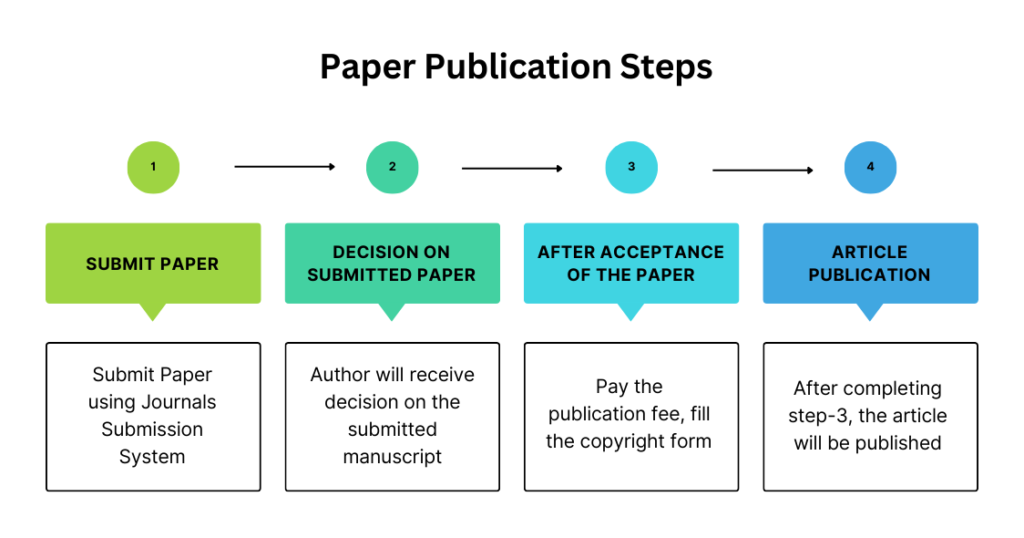
Step 10: Submit Your Manuscript
What to do:
- Prepare all required files: manuscript, cover letter, author details, conflict-of-interest statement, and any supplementary materials.
- Write a concise cover letter explaining your paper's contribution and why it fits the journal.
- Submit through the journal's official portal (most use online systems like Editorial Manager, ScholarOne, or OJS).
- Suggest reviewers if requested, avoiding conflicts of interest.
Step 11: Navigate Peer Review and Revisions
What to expect:
- Desk review — editor checks basic fit and quality (can result in quick rejection)
- Peer review — 2–3 external experts assess your work (typically weeks to several months)
- Decision: Accept, Minor Revision, Major Revision, or Reject
What to do with reviewer feedback:
- Address every comment point-by-point in a formal response letter.
- Where you disagree, explain your reasoning respectfully with evidence — you don't have to accept every suggestion, but you must respond to all of them.
- Resubmit within the given deadline.
Common mistake: Taking rejection personally or ignoring reviewer comments instead of treating them as a roadmap for a stronger paper (or a better-fit journal).
Step 12: Publication and Beyond
Once accepted:
- Complete any final proofs, copyright forms, and licensing choices (open-access license, if applicable).
- Confirm your paper is properly indexed where the journal claims (check the indexing database directly once it's live).
- Add the publication to your Google Scholar profile, ORCID record, and CV/portfolio.
- Share it appropriately (academic networks, institutional repository, social media) — respecting any embargo or copyright terms.
Roadmaps by Researcher Type
Undergraduate Students
Research project → Paper → Conference/Journal → Research profile
- Scope: Small, focused, often course- or capstone-linked
- Method: Simple, feasible with limited resources (surveys, small datasets, literature reviews)
- Target: Student conferences, national journals, or accessible international journals
- Goal: Build experience and, where feasible, complete at least one quality paper before graduation — this strengthens applications for jobs, scholarships, and graduate study
Master's / Graduate Students
Thesis → Manuscript → Journal submission → Further study/career
- Scope: Aligned with thesis chapters; often one paper per major thesis component
- Method: More rigorous, supervisor-guided
- Target: Mid-tier national or international journals, sometimes conferences first
- Goal: Strengthen thesis defense and build a base for PhD applications or industry credibility
PhD Researchers
Research studies → Publications → Academic/research career
- Scope: Multiple interconnected studies forming a coherent research program
- Method: High rigor; often original data or advanced computational methods
- Target: Field-leading, indexed journals; cumulative publications often required for graduation
- Goal: Build a publication record supporting an academic or research career
Independent Researchers
Focused problem → Study → Manuscript → Appropriate venue
- Scope: Narrow, self-directed, feasible without institutional resources
- Method: Often literature-based, secondary-data analysis, or small-scale primary research
- Target: Open-access journals or accessible national/international outlets
- Goal: Establish credibility without institutional backing; consider collaborating with an affiliated co-author or mentor for guidance and ethics support
Researchers Preparing for Study Abroad
- Prioritize publications (even short communications) that demonstrate research capability to admissions committees
- Favor internationally recognized, indexed venues over purely local ones
- Keep ORCID and Google Scholar profiles updated and complete
Researchers Targeting Academic/Career Promotion
- Check your institution's specific publication requirements (journal tier, quantity, authorship position) — these vary significantly
- Prioritize quality and indexing status over quantity
- Track record consistency (regular publishing) often matters as much as single high-impact papers
Working Professionals Conducting Research Alongside Work
- Scope: Practical, often tied to workplace problems (applied/action research works well)
- Method: Feasible within limited time — secondary data, case studies, or small-scale studies
- Target: Applied or industry-relevant journals and conferences
- Goal: Build credibility in your field without requiring a full-time research schedule
Nepal-Specific Considerations
- University/supervisor requirements: Many Nepali universities have specific thesis-to-publication or authorship requirements — confirm these directly with your department, as they vary by institution and program.
- Ethics approval: If your research involves human participants, sensitive data, or vulnerable groups, check whether your institution or an ethics review board (e.g., Nepal Health Research Council for health-related studies) requires prior approval.
- Institutional affiliation: Listing your university/organization affiliation accurately is expected; independent researchers can note their independent status or an academic collaborator's affiliation where relevant.
- Publication costs: APCs and submission fees vary widely — confirm current amounts directly with the journal, and check whether your institution offers any fee-waiver or funding support.
- Authorship and collaboration: Agree on authorship order and contributions early, ideally in writing, to avoid disputes later.
- Plagiarism: Always run your manuscript through a similarity/plagiarism check before submission; most journals reject or retract papers with excessive overlap.
- Copyright: Understand what rights you retain versus transfer to the publisher — read the copyright/licensing agreement before signing.
- ORCID: Register for a free ORCID iD early — many journals now request it, and it consistently links your publications under one identity.
- Google Scholar: Set up a profile once you have your first publication to build a citable, discoverable research record.
Common Mistakes Checklist
- [ ] Topic too broad or too vague to research within your timeframe
- [ ] Weak or unclear research gap
- [ ] Methodology mismatched to the research question
- [ ] Insufficient sample size or evidence to support conclusions
- [ ] Plagiarism or excessive text overlap with existing work
- [ ] Inappropriate or undisclosed AI use in writing or data analysis
- [ ] Submitting to a journal outside your topic's scope
- [ ] Falling for a predatory journal or conference
- [ ] Ignoring author guidelines (formatting, word limits, citation style)
- [ ] Expecting publication within days/weeks — realistic timelines are often months
- [ ] Not responding fully to reviewer comments during revision
Where KhojByte Fits In
If you'd like structured support at any stage — refining a research idea, choosing a methodology, running data analysis, preparing a manuscript, editing for language and clarity, or identifying a suitable, credible journal — KhojByte Research Lab offers mentor-guided publication consultation built specifically around this process, from idea to indexed paper. It's one option among several; whichever path you choose, the steps above remain the same.
Have questions about your specific research stage? Explore KhojByte's research ideas or request mentor guidance to get personalized direction.